How to Structure Your Money in Your 20s: The 3-Bucket Strategy Explained
Your 20s are often the first time you truly control your money. You start earning. And sometimes, you finally start living… with a sense of freedom.
But your first income does not only bring freedom of choice. It also brings the responsibility of making the right financial choices.
As soon as you start earning, suddenly advice starts coming from everywhere — parents, friends, social media, and finance influencers.
“Save more.”
“Start investing.”
“Do SIPs.”
“Build an emergency fund.”
You understand the importance of each of these suggestions. At the same time, you also want to fulfill dreams you could not earlier. Travel. Experiences. Small luxuries. Independence… And somewhere along the way, many people in their 20s get labelled as careless or financially immature.
But after speaking with many young professionals, I’ve realised something important. They are not careless. They are clueless. And it is not because they lack intelligence or discipline, but because our education system rarely teaches us how to actually manage money.
People give plenty of financial advice, but very few explain how to actually structure your finances. So many people in their 20s end up doing what they believe is right:
Saving a little here.
Starting a random SIP.
Keeping some idle cash in the bank.
Buying a few stocks recommended by friends.
Individually, none of these decisions are wrong. But without a clear structure, money often ends up scattered. And the result you feel like you are doing something with your money…but you are never quite sure if you are doing the right things in the right order.
With this blog I aim to give you some clarity and structure for your money.
The Most Popular Money Rule Everyone Talks About
If you’ve ever tried to figure out your finances, chances are you’ve come across the 50:30:20 rule. It’s one of the most widely recommended budgeting frameworks.
The idea is simple:
- 50% for Needs — rent, groceries, bills, essentials
- 30% for Wants — lifestyle, eating out, travel
- 20% for Savings and Investments
At first glance, this feels perfect. It’s simple. It’s easy to remember. And it gives you a sense of control over your money. For many people, this is the first time finances feel structured. But, as soon the initial excitement fades money people again find them asking the same question “Am I doing it right? Is my finances going in the right direction?”
The problem isn’t that the rule is wrong. The problem is that it’s incomplete. It tells you how much to save…but not what to do with that money once you’ve saved it.
Let’s say you’re doing everything ‘correctly.’ You’re saving 20% of your income every month. Now what?
Do you:
Start a SIP?
Build an emergency fund?
Save for a trip?
Put it in a fixed deposit?
This is exactly where most young earners get stuck. Because all of these goals get mixed into one vague category called ‘savings.’
And when everything is treated the same…money starts moving randomly instead of intentionally. You invest a little here. Save a little there. Try something someone suggested. Individually, nothing feels wrong. But together, it creates the same feeling you started with: CONFUSION.
So instead of just budgeting your money… what if you could assign a clear role to every rupee you earn? Let me tell you how.
A Simpler Way to Handle Your Money: The 3 Bucket Strategy
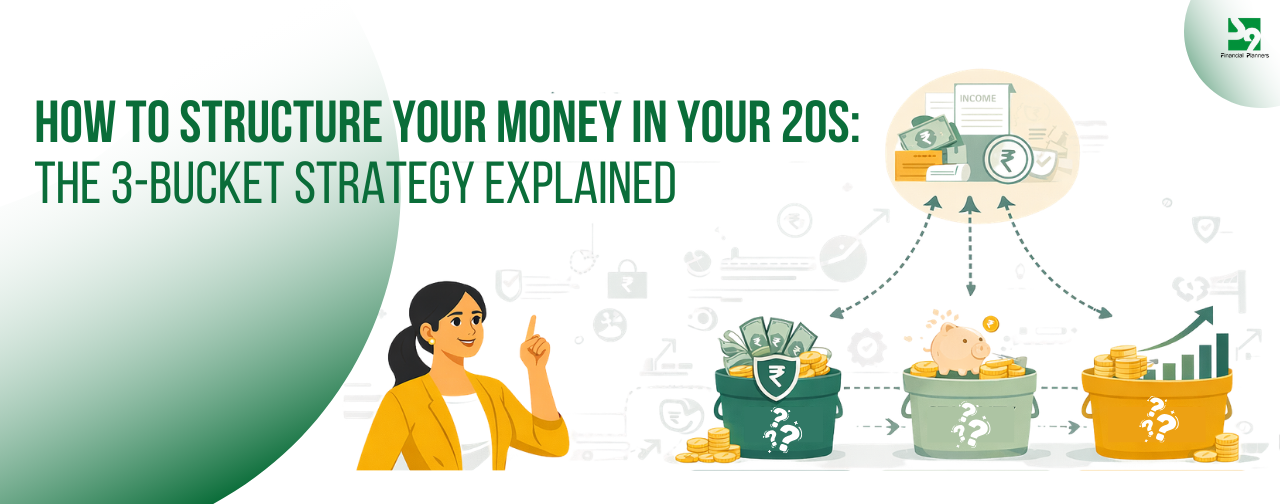
Instead of thinking in terms of saving vs investing, you need to start think in terms of purpose. Every rupee you earn has a job. And broadly, that job falls into one of three categories:
- Protect you
- Support your near-term goals
- Grow your long-term wealth
This is the foundation of the 3-Bucket Strategy:
- Safety Bucket → for protection
- Stability Bucket → for short-term goals
- Growth Bucket → for long-term wealth
It’s simple. But more importantly, it answers a question most people struggle with: “Where should my money actually go?”
Let’s break down each of these buckets and understand how they work.
Safety Bucket — Your Financial Cushion
This is the most important bucket and also the most ignored one. Your Safety Bucket is your financial protection against life’s uncertainties. Because no matter how stable life feels right now, unexpected events like job loss, medical emergencies or sudden responsibilities can happen.
Without a safety net, even a small disruption can push you into debt or force you to break your investments. That’s why having a safety bucket for your emergency funds is a non-negotiable. And this is the bucket you start filling first.
Now, you might be wondering how much money to put in this bucket. And, there’s a very straightforward answer to this: 3 to 6 months of your living expenses.
And where do you keep this money?
Emergency funds are meant for emergency situations and hence they need to be kept in liquid. Savings account, liquid funds and sweep in FDs can be the place where you keep the money meant for your emergency.
Never ever invest this fund in any market-linked product or put in a fund with lock-in periods. Remember the goal of an emergency fund is quick access and peace of mind not high returns.
Stability Bucket — Your Short-Term Plans
Now that your safety is taken care of, the next question becomes: What about the goals you know are coming?
Not emergencies. Not 20-years-away dreams. The ones that are somewhere in between.
A trip you’ve been planning.
A course you want to take.
Maybe a vehicle. Maybe a wedding.
These are not someday goals in an unforeseeable future. They’re 2–5 year goals. And here’s where many people make a mistake. They either keep this money in savings and lose out on growth, or invest it aggressively and take unnecessary risk. Both can backfire because this money has a timeline.
Stability bucket stores your dreams with limited time. So, protecting your money here is more important than miximising returns. But, you can’t also let this money sit idle like emergency fund. Here your timelines are defined and you can plan well.
So where does this money go?
You can ideally put this money into:
- Fixed deposits
- Short-term debt funds
- Recurring deposits
- Conservative hybrid funds
You can think of this bucket as: “I don’t want to lose this money, but I also don’t want it sitting idle.” That balance is what stability is all about.
Growth Bucket — Your Wealth Builder
Now we come to the bucket that most people get excited about. Investments. SIPs. Markets. This is the Growth Bucket. This money is not for next year. It’s not even for the next five years. This is for goals that are far away but deeply important.
The goals like financial independence, retirement, long-term wealth etc comes in your growth bucket. And because this money has time on its side, it can handle ups and downs. This is the money which you want to work hard for you.
Some people hesitate at this point thinking what if the market fell and I lose my money. If you are one of those conservative people, let me tell you that markets are surely unpredictable in short term but in long term markets have always gone up.
Once your security and stability buckets are taken care of, not investing is a bigger risk than the market risks.
The money in this bucket should be invested in well-diversified funds and allowed time to compound. And, this is the biggest advantage of being in your 20s that with time on your side, you can take risks.
If I were writing the same topic for people in their 30s and 40s, I would have taken a more conservative stance. So, if you are in your 20s, start investing for growth (obviously only after building your safety net).
Now while this framework works for everyone, I emphasis women in their 20s to follow it religiously. Because for them, it can be even more powerful and empowering.
Why This Matters Even More for Women in Their 20s
Money decisions are never just about numbers. They are deeply connected to the kind of life you want to live and the choices you may have to make along the way.
And for many women, that journey doesn’t always follow a straight line.
You start earning, you build momentum and then life can shift. Maybe it’s marriage. Maybe it’s a career break due to pregnancy. Maybe it’s choosing family over work for a period of time. Not because you lack ambition. But because priorities evolve.
And in those moments, money starts playing a very different role.
It’s no longer just about growth. It becomes about security… independence… and having options. That’s why structuring your finances early matters so much.
Because when you already have a system in place:
- Your Safety Bucket becomes your cushion during uncertain phases.
- Your Stability Bucket keeps your near-term plans from falling apart.
- Your Growth Bucket continues building your future quietly in the background.
And slowly, something shifts. You stop feeling like life decisions are limited by money. You start feeling like you have a say in how your life unfolds. Because financial independence is not just about earning more. It’s about knowing that even if life doesn’t go exactly as planned…you’ve built a structure that will still support you.
So Where Does the 50:30:20 Rule Fit In?
Now you might be thinking…“Okay, this 3-bucket idea makes sense but what about the 50:30:20 rule everyone talks about?”
Should you follow that? Or ignore it completely?
As I said earlier, the 50:30:20 rule is not wrong but it’s also not complete either.
The 50:30:20 rule is great at helping you answer how much can you spend and how much you must save. But, it fails to answer where should your money go once you saved it.
So instead of choosing between the two, think of them as working together. The 50:30:20 rule helps you control your lifestyle. The 3-bucket strategy helps you control your financial direction.
So your flow becomes simple: You earn → You divide your income → And then you assign purpose to your savings
Let’s understand this with example. Out of your income:
- 50% goes into needs
- 30% goes into lifestyle
- 20% goes into savings
Now instead of treating that 20% as one block you split it into:
- Safety
- Stability
- Growth
And this way you build a system for your money that does not only give safety, stability and growth but also clarity.
What This Looks Like in Real Life
Let’s say you earn ₹60,000 per month. After managing your expenses, you’re able to set aside ₹20,000. Now instead of randomly allocating this you structure it.
- ₹5,000 goes into your Safety Bucket (until your emergency fund is ready)
- ₹5,000 goes into your Stability Bucket (for near-term goals)
- ₹10,000 goes into your Growth Bucket (SIPs and long-term investing)
Now here’s the interesting part. Once your emergency fund is fully built, that ₹5,000 doesn’t stop. It simply moves into your Growth Bucket.
And just like that, your investments increase without you feeling the pressure. No guesswork. No confusion. Just a system that evolves with you.
Final Words
Your 20s, is about learning how to make decisions without having all the answers yet. You will try things. You will make mistakes. You will change your priorities. That’s part of the journey.
But what makes the biggest difference in your finances is finding clarity and direction for your money. Because when money is structured things start to feel simpler. Decisions feel lighter. Uncertainty feels more manageable. And slowly, you stop reacting to money and start feeling in control of it.