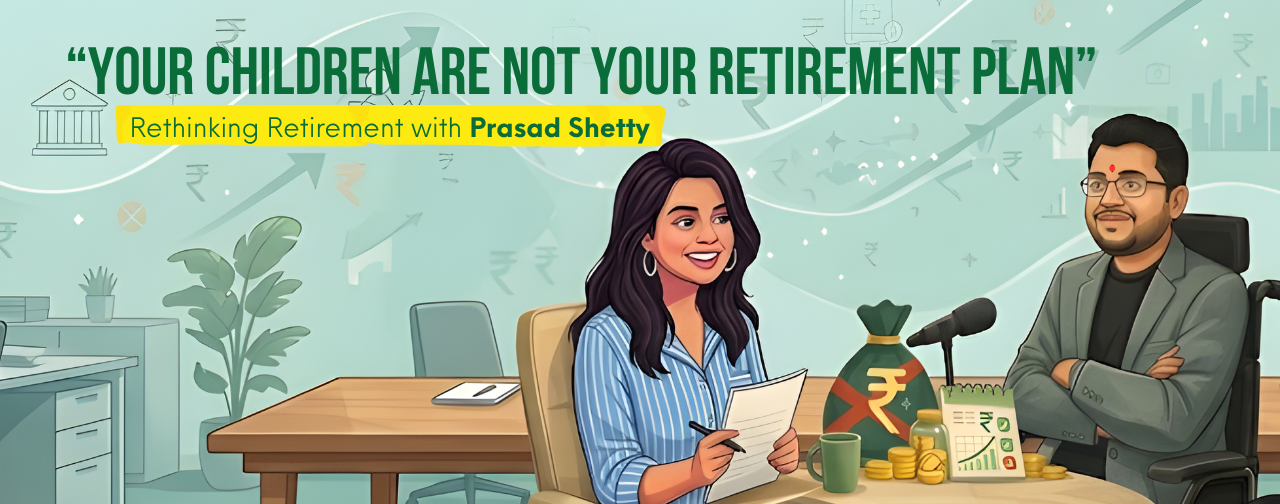
“Your Children Are Not Your Retirement Plan” – Rethinking Retirement with Prasad Shetty
April 8, 2026/ Urmila Singh
Prasad, before we get into frameworks and planning — what made this such a strong mission for you? Why do you call 'Retire with Dignity' your mission?
Thanks for asking, Urmila. And honestly, this didn't start in an office or as a strategic decision. It started with my observation and passion.
I've always found myself naturally connecting with older people — my father, my uncles, even people in old age homes. And over time, I noticed a pattern that moved me.
Most of the old people were not struggling because they didn't earn enough. They were struggling because they never kept anything for themselves. My father gave both his children his all — which sounds very noble, but at what cost? Do you know how many people in old age homes are not actually poor?
If a person doesn't plan for their retirement, financial dependence creeps in very quietly. First, small adjustments. Then some small compromises. And slowly, decision-making shifts away from you.
"Retirement is not a money problem. It's a dignity problem."
— Prasad ShettyBecause the day you can't make your own financial decisions… something inside you changes.
That's a strong statement — 'dignity problem.' And your mention of old age homes really adds depth to it. But today, there's so much awareness, especially with concepts like FIRE. People are planning early. Isn't that a positive shift?
It absolutely is. I'm very happy that people are thinking about financial independence early. But I feel the conversation is incomplete at a few points.
A lot of focus today is on "How fast can I reach a number?" But very little focus is on "What happens after I reach it?"
Even early retirement is still retirement. And retirement is not just financial — it's emotional and structural. If you don't design your income, your identity, your daily structure… then even financial independence can feel empty or unstable.
So I'm not against FIRE. I just believe we should not chase an early exit at the cost of long-term dignity.
That brings me to something I see clients struggle with all the time — everyone wants a number. ₹3 crore, ₹5 crore, ₹10 crore. Why do you strongly push back on this?
Because that number gives false comfort. Simple.
A lot of people today are following some finance influencer and deciding their 'magic number' based on content — not their actual life scenarios. They get attached to that number and feel that once they achieve it, life will be sorted.
"Retirement doesn't run on a corpus. It runs on a cash flow."
— Prasad ShettyYour life doesn't happen in crores. You need a monthly cash flow for your bills to be paid and life to run smoothly. When you plan in terms of corpus, you're treating retirement as a one-time number. That's the disconnect.
I've seen people with ₹5 crore feel anxious… and people with ₹3 crore feel completely at peace. The difference is not the amount — it's the system that makes their money replicate a salary after retirement.
That's where your S.I.P framework comes in, right? Can you break that down for our readers?
Sure — and I wish more people understood this. My S.I.P framework is what I call the S.I.P of Retirement Dignity.
During your working life, everything runs on a salary. A good retirement plan must recreate that predictable, structured income — not random withdrawals. When income is predictable, anxiety reduces.
Knowing where your money is, how it generates income, and how your family can access it. Scattered investments, missing passwords, and unclear nominations are silent risks in retirement.
Life doesn't follow plans. Medical emergencies happen. If your money is inaccessible in times of surprise, you may be wealthy — but still feel helpless. Liquidity is what gives you control.
This is where I feel many advisors miss the point. As a CFP, even I see a lot of focus on accumulation and returns. What do you think needs to change in how financial planners approach retirement?
Honestly, a lot. Our fraternity needs to stop seeing ourselves as money planners or product advisors — and start acting like financial coaches. We need to educate our clients.
Because clients don't just need portfolios. They need understanding. Today, most financial plans answer: where to invest, and how much return to expect. But very few answer:
- How will this turn into monthly income?
- How will this behave during market volatility?
- Will this protect the client's independence?
"Adhura gyaan khatarnak hota hai. Half knowledge in finance can cost someone their dignity."
— Prasad ShettyIf you are talking only in terms of 'corpus', you are giving your client half knowledge. We need to educate clients, not impress them.
There's one uncomfortable question I want to ask — many people still believe their children will take care of them. How do you see that?
In our Indian culture, this is definitely an uncomfortable topic. But when you're on a mission to create change at scale, you have to get comfortable with uncomfortable conversations.
"Your children are not your retirement plan. Not because they won't support you — but because they shouldn't have to carry that responsibility."
— Prasad ShettyTheir lives will come with their own financial pressures, uncertainties, and responsibilities. And when dependence enters a relationship, things start changing — subtly, but surely.
And interestingly, our society works like a double-edged sword here. On one side, parents expect their children to take care of them in retirement. On the other side, the same parents feel it's their moral duty to spend everything on their children — even their last rupee.
I still tell my clients: "Your child can take an education loan for higher studies… but you won't get a loan for your retirement."
Retirement planning should come before the goal of higher education for children. People need to learn to prioritise their financial goals logically, not emotionally.
One last dimension I want to touch on — something you've spoken about before — the identity shift after retirement. How important is that in planning?
It's critical. And almost completely ignored. For 30–40 years, your profession is your identity. And then one day… it's gone.
That transition can feel much heavier than the financial shift. Money can give you freedom. But it cannot give you purpose. That's something you have to design.
A healthy retirement needs purpose, contribution, routine, and relationships. Otherwise, even a financially secure retirement can feel empty.
Last question. If someone reading this hasn't started yet — what's the first mindset shift they need?
Stop asking: "How much do I need?"
And start asking: "How will my money show up for me every month?"
Don't see retirement as the end of earning. See it as the beginning of your money earning for you.
If your plan protects your choices, your independence, your peace of mind — then you've not just built wealth. You've protected your dignity.
"The day you can no longer make your own financial decisions, something inside you changes. Plan before that day arrives."
Start Planning with S9 →Tags
Author: Urmila Singh
She is our ace Financial planner who has over 8 years of experience in the finance industry. A Certified Financial Planner from FPSB India and with an MBA in Finance degree along with NSE – Capital Market Certification, Qualified Personal Finance Professional (QPFP) Certification makes her the best in her domain and that is why her clients are so comfortable interacting with her. She is very passionate about traveling, swimming and dancing when she is not occupied with client meetings.